
What Is Cloud Data Engineering? A Complete Guide for Modern Businesses
Introduction
Data has become one of the most valuable assets for modern organizations. Every customer interaction, application transaction, marketing campaign, and operational process generates data that can be transformed into business intelligence. However, collecting data is only the beginning. Organizations must be able to ingest, process, store, govern, and deliver data efficiently to realize its value.
This is where Cloud Data Engineering plays a critical role.
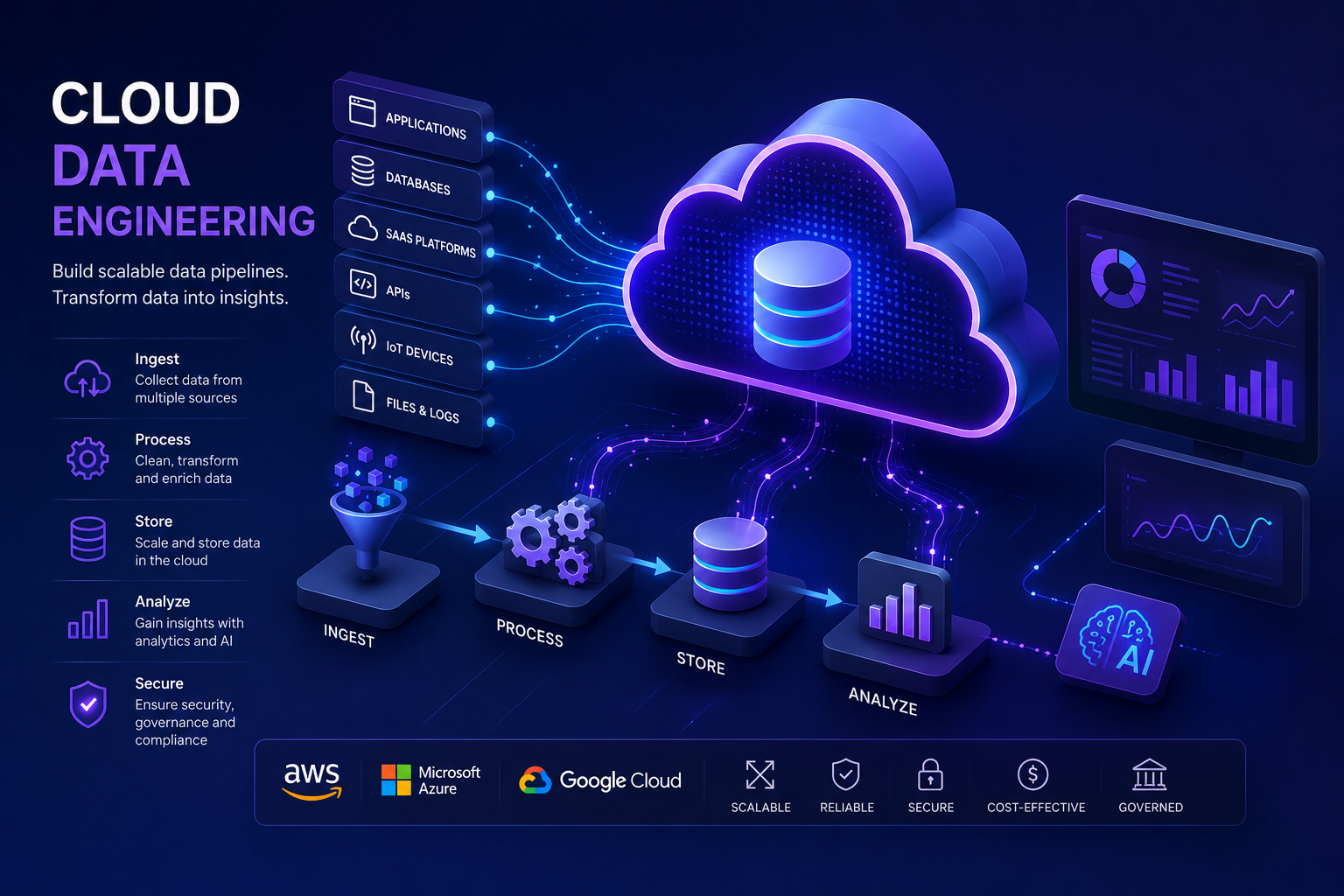
Cloud Data Engineering is the practice of designing, building, and maintaining scalable data systems using cloud technologies. It enables businesses to process large volumes of data, support analytics initiatives, power artificial intelligence applications, and provide real-time insights across the organization.
As businesses continue to adopt cloud-first strategies, cloud data engineering has evolved from a technical necessity into a strategic capability that drives innovation, efficiency, and competitive advantage.
What Is Cloud Data Engineering?
Cloud Data Engineering focuses on creating reliable data pipelines and platforms that move data from source systems into analytical and operational environments.
A cloud data engineer is responsible for:
Designing data architectures
Building data pipelines
Integrating multiple systems
Ensuring data quality
Managing data storage
Optimizing performance
Implementing governance and security
Supporting analytics and AI initiatives
The goal is to ensure the right data reaches the right people and systems at the right time.
Why Traditional Data Systems Are No Longer Enough
Many organizations still rely on legacy on-premise infrastructure that was designed for predictable workloads and limited data volumes.
These environments often struggle with:
Scalability Challenges
As data volumes increase, traditional systems become expensive and difficult to scale.
Slow Analytics
Batch processing methods often delay critical business insights.
Data Silos
Information is spread across multiple disconnected applications.
High Maintenance Costs
Managing hardware, storage, and infrastructure consumes significant resources.
Limited Innovation
Legacy systems make it difficult to adopt modern technologies such as AI, machine learning, and real-time analytics.
Cloud data engineering addresses these limitations by leveraging the flexibility and scalability of cloud platforms.
Core Components of Cloud Data Engineering
Data Ingestion
The first step is collecting data from various sources.
Examples include:
CRM systems
ERP platforms
SaaS applications
Databases
APIs
IoT devices
Streaming platforms
Data can be ingested in real time or through scheduled batch processes.
Data Storage
Cloud platforms provide multiple storage options.
Data Lakes
Store raw structured and unstructured data at scale.
Benefits include:
Low cost
High scalability
Flexible schema
Data Warehouses
Designed for analytics and reporting.
Benefits include:
Fast query performance
Structured data models
Business intelligence integration
Data Transformation
Raw data often requires cleansing and transformation before it becomes useful.
Typical transformations include:
Standardization
Validation
Aggregation
Deduplication
Enrichment
This process ensures data consistency and quality.
Data Orchestration
Modern data environments consist of hundreds of interconnected workflows.
Data orchestration automates:
Scheduling
Dependencies
Monitoring
Error handling
Recovery
This improves reliability and operational efficiency.
Data Governance
Governance ensures data remains:
Secure
Accurate
Compliant
Auditable
Strong governance frameworks become increasingly important as organizations adopt AI and analytics initiatives.
Benefits of Cloud Data Engineering
Scalability
Cloud platforms can scale resources dynamically based on workload requirements.
Cost Optimization
Organizations only pay for the resources they consume.
Faster Innovation
Teams can deploy new pipelines and analytics solutions quickly.
Improved Reliability
Cloud-native architectures provide redundancy and automated recovery.
Real-Time Insights
Businesses can make decisions based on current information instead of historical reports.
AI Readiness
Well-engineered data platforms provide the foundation required for machine learning and AI initiatives.
Cloud Data Engineering Best Practices
Build Modular Pipelines
Modular architectures improve maintainability and scalability.
Automate Monitoring
Implement automated alerting and observability from day one.
Prioritize Data Quality
Poor data quality creates downstream issues that are expensive to resolve.
Implement Governance Early
Security and compliance should be integrated into the platform architecture.
Design for Scale
Even small projects should be built with future growth in mind.
The Future of Cloud Data Engineering
The future of cloud data engineering is being shaped by:
AI-assisted development
Autonomous data operations
Real-time analytics
Data mesh architectures
Intelligent orchestration
Generative AI applications
Organizations that invest in modern data foundations today will be better positioned to leverage these innovations tomorrow.
Conclusion
Cloud data engineering has become a foundational capability for modern organizations. It enables businesses to transform raw data into actionable intelligence, support advanced analytics, and power AI-driven innovation.
By adopting scalable cloud-native architectures, organizations can improve efficiency, accelerate decision-making, and create sustainable competitive advantages.
As data volumes continue to grow, cloud data engineering will remain one of the most important investments businesses can make in their digital transformation journey.
About Pluviant
Pluviant helps organizations design, implement, and optimize cloud-native data platforms, AI solutions, and integration architectures that deliver measurable business outcomes.